PP: The Geo-Strategic significance of Gaza

PONDERING POINTS: Short, quick-and-dirty pieces of thinking out loud

PP1: The The Geo-Strategic Significance of Gaza

©Andre ZAAIMAN 2014


“Thus in the beginning the world was so made that certain signs come before certain events.”  

Cicero

The current violent assault by Israel on a territory (Gaza) and a people (Palestinians) that it has displaced and occupies – and on Hamas in particular – has, at a tactical level, its domestic roots in the 2005 unilateral “withdrawal” of Israel from Gaza by the then Government of Ariel SHARON. It signaled the end of the “peace process” which had already by then, especially following the 1995 murder of Yitzhak RABIN by a fellow Israeli Jew and the death of the Palestinian leader Yasser ARAFAT in 2004 – a year after the 2003 US invasion of Iraq – started to morph from a real peace process into a mere extension of war-by-other-means.

As indicated amongst other things by several Israeli military Operations such as Defensive Wall (2002), Cast Lead (2008/9) and now Protective Edge (2014) – all militarily aimed at but failing to restore Israeli deterrence – as well as the unabated construction and expansion of settlements in the West Bank and the Jerusalem area, that the principal tactical goals for Israel in its domestic and regional theaters are respectively:

  1. The division of the Palestinians, geographically (physical) and organizationally (as a political movement), in order to fragment and ultimately conquer the West Bank and make the establishment of a viable Palestinian State, impossible. This divide-and-rule method is as old as colonial conquest itself and is one of the reasons why Israeli historians such as Ilan PAPPE calls this ethnic cleansing. It is also why the recent rapprochement between Fatah and Hamas is one of the principal reasons why Israel decided to go after Hamas now: Israel wants the Palestinians to remain divided and fractured; and it wants Hamas (which analytically fits into the broader ambit of Political Islam), to become depoliticized and disarmed. In the long run, it is still pursuing the defeat of the Palestinian national movement, the reduction in the numbers of the Palestinian population in the area as a whole, and the obliteration of any forms or traces of Palestinian history in historical Palestine.
  2. The re-establishment of the regional status quo ante bellum – meaning as it was before the Arab Spring and rise of Political Islam in the Middle East. Current dominant groups in Israel, as well as those in Saudi Arabia, Egypt, Bahrain and the Emirates cannot afford that a situation of real, majoritarian democracy based on free and fair elections in which all their citizens participate freely and equally, prevails: at least in the case of Israel, until it has reduced the Palestinian (non-Jewish) numbers through a process of social and geographical attrition to such an extent, that it would never pose a threat to the ethnic concept of a Jewish State, secured through the engineering – by means of a series of wars, expulsions, geo-political “facts-on-the-ground” and annexations – of a “permanent Jewish majority”. This process started in 1947 and continues to this day; it explains the national obsession of Israelis with demographics and geography. From an Israeli perspective, until the Palestinians are bludgeoned and weakened to the point where they accept this exclusivist, ethnic and Jewish character of the State of Israel and permanently give up any historical claims to the land of their birth, there can simply be no peace.

Reverting back to the status quo ante bellum, will therefore permit Israel, Saudi Arabia, Egypt and others to once more demonize, marginalize and diminish the forces of Political Islam (which includes Hamas) and recapture the strategic initiative. Moderate forces such as those of Political Islam that can square Islam and Democracy (for example such as in Turkey) therefore pose a real threat to the interests of Israel and Saudi Arabia, hence both countries prefer radical Islamic variants as opposition, which can be thought and fought through the trope of “fighting terrorists”. That off course should not be read as the slightest endorsement of terrorism – this is an analytic exercise aimed at understanding and not a treatise on morals or moral judgment: terrorism in any form is obviously quite simply, wrong. Fighting settler colonial occupation and expansion should however not be equated with terrorism either; there is no moral equivalence between an Occupier and the Occupied. And Israel is, under international law, an Occupier.

Viewed as a complex system, the Middle East can only be understood as the simultaneous interplay of various components. These components interact horizontally with each other within three scales: domestic, regional and global. But these components also interact vertically between scales creating an intricate, dynamic interplay of individual actors, groups, coalitions and alliances. It can be visualized as an adapted Rubik’s Cube.

Rubik's Cube Not understanding these horizontal and vertical relationships and interactions will render a proper understanding of the current situation rather difficult if not impossible.

The oversimplifications below should therefore be understood as a first attempt to start drawing initial, broad lines of an eventual analysis primarily focused on the higher, strategic level: and not as a deliberate neglect of detail or cutting with a blunt knife.

We would first like to start with two caveats and one observation:

  1. Caveat: The views of the Obama White House on these matters differ in significant ways from the majority views on Capitol Hill; but the White House views are more in synch with the sentiments of the majority of Americans. The restocking of Israeli munitions by the US, which takes place under their existing treaties and legal obligations to each other, was deliberately leaked to the Press by the Israelis as a way embarrass Obama and to cover up their feud.
  2. Caveat: Obama will not be President forever: the next US President is more likely to step in line with the views of Capitol Hill; views that are heavily influenced by the powerful, well-organized and monied pro-Israeli lobbies.
  3. Observation: In the current situation, there are significant misalignments and divergences between US and Israeli strategies in the Middle East, revealed through their differing positions on both the Iranian and the Palestinian issues.

Operation Protective Edge was launched by Israel following its initiation through a fabricated trigger, a favored technique of the Israeli security establishment. But just as the incessant focus of Israel on Iran’s supposed nuclear weapons program, Gaza and Operation Protective Edge is a ruse; a distraction and obfuscation of the real target which in this instance, at the tactical level, is the West Bank and the Jerusalem area which is central to making the establishment of a viable Palestinian State, impossible. Regionally, the strategic target for Israel (and Saudi Arabia), remains Iran – and therefore the subversion of the current White House outreach to Iran and the nuclear negotiations – since they have already successfully reversed the effects of the wave of popular uprisings which helped bringing forces of Political Islam initially in power in places such as Egypt, Tunisia and Gaza (Hamas).

Israel, Saudi Arabia and Egypt wants to return to the regional situation where forces of Political Islam (such as Hamas in Palestine and the Muslim Brotherhood in Egypt) are perceived as “terrorists”, internationally isolated and turned into outlaws. Iran must also once more be perceived as the grave “threat” – in much the same vein as Saddam HUSSAIN’s Iraq was portrayed until it was militarily attacked and invaded by the US.

Operation Protective Edge, when seen from this vantage point, therefore forms part of a broader, regional strategy by Israel, Egypt and Saudi Arabia to seize back the initiative from Turkey and Qatar and ultimately to end the Iranian rapprochement. The overthrow of the Mursi- Government in Egypt and the attempted destruction of Hamas in Gaza through Operation Protective Edge, are therefore not separate events but intimately linked.

As we have argued before in another piece on this Website (The US-China-Africa Part 1 America: see MENU on your right), the current world order has entered a phase of decomposition and realignment of forces. This military assault on Gaza must also be located within this context too and several other international, regional and domestic driving factors must be considered as well, which include:

  1. The 2003 invasion of Iraq by the USA, actively but stealthily pushed and nurtured by Israel and Saudi Arabia at the time
  2. The subsequent decline of American influence in the Middle East and the general weakening of its strategic position in the world
  3. The US Pivot or Re-Balancing to Asia and its outreach to Iran
  4. The rise of political Islam in the Middle East through the Arab Spring and its reversal starting in Egypt following Turkish over-reach
  5. The emergence of countries (Russia and China) and alliances (BRICS) that are perceived to threaten American primacy
  6. Hyper-connectivity and Technology that facilitates rapid flows of both information and new forms of informational weaponry

We can therefore begin to make the argument that both Israel and Saudi Arabia seem to be adjusting, sometimes quite violently, to the reality of the absence of an active and offensive, US military prioritization in and of the region: Asia, Eastern Europe and to a lesser extent Africa seem to be the new American military priorities. The Middle Eastern political and security game is influenced by the global, geo-strategic moves of America, China and Russia; but its actors are increasingly regional and driven by the conflicting interests of their own regional positions and interests.

This implies that both countries (Israel and Saudi Arabia and their allies,) are likely to get more directly involved (albeit through proxies) in places ranging from Lebanon to Syria and Iraq – they will rely less on the US to “do the dirty work” in a manner-of-speaking. The outbursts and defiance of Israel in respect of some of the initiatives of OBAMA and KERRY concerning Operation Protective Edge in Gaza, a clear sign that they have understood that they must take decisive action when their interests require it; even if this comes at the price of tension with their principal big power ally, the USA. But this also means that actors such as Russia will, for geo-strategic reasons, become more directly involved too. Hence the metaphor of the Rubik’s Cube becomes important again as an analytical tool.

The successful reversal of the initial ascendency of political Islam by Saudi-Arabia, Israel, Egypt and the Emiratis has solidified their loose alliance based on a convergence of interests. From an Israeli perspective, this is useful in terms of intelligence and military coordination and cooperation, but highly embarrassing from the point of view of its diplomacy: it needs to present itself as democratic and Western because its national security concept was hitherto based on this.

But it now finds itself in the company of states that nobody would really hold up as beacons of human rights and democracy.

As key international actors are in the process of repositioning (strategy, goals, capabilities); recalibrating (their perceptions and calculations of themselves and others) and reconfiguring (power and alliances), countries will have to adjust and adapt. This reconfiguring of power-balances brings with it significant winners and losers – countries that will behave differently if not irrationally, as a consequence of either losing or gaining of influence and power. For example, presently Turkey and Qatar – key sponsors of the various projects of Political Islam – are licking their wounds and regrouping, whilst Iran has significantly improved its prospects. Israel suffers from the cancer that all projects based on dispossession and violent occupation suffer from and in the long run succumb to: moral degeneration from within. Israel and Saudi Arabia, having built their strategic and national security conceptions upon a close attachment to a great Power – the USA in particular – have found both the military withdrawals from the Middle East and the Pivot to Asia disconcerting. The overtures of the Obama White House to Iran being almost the final straw that “broke the camels back.”

The current tension between Obama’s White House, Israel and Saudi Arabia has been long in the making. Leaving aside the specific characteristics and brash conduct of the current Israeli Prime Minister, including the condescending attitudes regularly on display towards the “naive” Americans – it was Obama’s tacit backing of the rise of Political Islam across the Middle East during the Arab Spring that really set off loud alarm bells in Tel Aviv and Riyadh.

To fully understand this, it is necessary to step back to the discussions and decisions about Strategy and Tactics in the movements of Political Islam during the late 1990s and early 2000’s. And to also revisit Israeli tactics during that period, most notably its widely reported announcements at the time, that it “would no longer guarantee the safety of Yasser ARAFAT (PLO) and his subsequent death in November 2004 in France. I will focus on Hamas – the bête noir for the Sharon and Netanyahu Governments, specifically the decision of Hamas in 2005 to pursue the path to political power through the ballot box in the Occupied Territories. For the sake of brevity and focus, I will not yet highlight in any detail the key roles of Qatar and Turkey in all of this.

In response to this decision and the subsequent electoral victory of Hamas in Gaza in free and fair elections in Gaza and the West-Bank in 2006, Israel and particularly Egypt under Hosni MUBARAK, convinced and coordinated closely with the Americans (under George W. BUSH) to overturn, subvert and set Hamas up to fail. America, Israel, Egypt, Jordan and to a lesser extent Saudi Arabia (with the cooperation of the Fatah at the time), strictly policed a very hard line that made it impossible and costly to give any legitimacy to Hamas: Hamas needed to fail and be isolated politically, financially and regionally: not even dialogue with Hamas was permitted.

And it is precisely this line that the Israelis, with nods from Cairo and Riyadh, now want to re-establish and of which Operation Protective Edge is not the beginning (it started with the Mursi overthrow in Egypt) nor the end but nonetheless forms an intricate part.

The South African Government at that time, had understood early on that once the Israeli guarantees of the safety of Yasser ARAFAT were removed, the probabilities of his incapacitation or death, rose significantly. And that the Palestinian movement represented by the PLO, would face severe internal difficulties if this were to occur. The Government therefore, presciently and wisely, carefully traversed and crossed these lines in order to keep itself abreast of developments in the ground: we established and maintained discreet channels of dialogue and communication with movements of Political Islam, including with Hamas. As a consequence, we were one of a very few countries in the world that were not surprised by the Hamas decision to participate in the 2006 elections in Gaza, or with their subsequent electoral victory in Gaza.
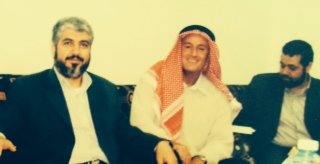
AZ Hamas Liaison

Khaled MESHAAL Andre ZAAIMAN Osama HAMDAN

When Obama came to power in the USA in 2008 he initially continued to pursue this hard-line position of his predecessors, but was eventually convinced that this situation was no longer tenable or sustainable. When the Arab Spring occurred, the Americans did very little to prop up their former allies in the Middle East, preferring to watch as the people basically coalesced into a popular uprising. This was an important strategic divergence between Israel, a Saudi Arabia and America that was followed eventually by a logical second one: the Obama rapprochement with Iran.

Some countries however will make the serious miscalculation of not correctly reading or adapting to a rapidly changing world. From a risk perspective the three countries in the Middle East that stand out in this respect at the moment, is Israel and the loose alliance it has constructed with Egypt (except for the brief period before the democratically elected Mursi-Administration was overthrown) and Saudi Arabia. The emergence of a new balance-of-forces or of alternative global architectures combined with rapid power shifts may well catch these countries off-guard and ill-prepared.

Judging from the very serious intelligence failure Israel has suffered as part of Operation Protective Edge – Hamas succeeded in building a vast and sophisticated network of underground bunkers, tunnels and factories undetected right under the noses of all the sophisticated Israeli surveillance – the prognosis does not seem very good. Israel is in a state of hubris and has started to believe its own rhetoric to such an extent, that it is behaving irrationally and will continue to make strategic miscalculations based on a misreading of what is going on around them.

Depending on which side of the fence one sits, this may either fill you with optimism or with a sense of alarm.

But this reconfiguration is not only driven horizontally in the form of shifting power-balances between nation states; there is also a vertical dynamic at play: between ordinary people and elites. Ordinary citizens of the world, in all parts of the world without exception, are desirous of profound changes in the way the global commons is governed: politically, economically, financially and socially. The plethora of social protests, uprisings and civic movements – a real yearning for the return of politics and people – that the world has seen over the last 10 years are not only directed specifically against Leader X or Party Y, but are expressions of a much deeper discontent with the “the way the world is organized and works”.

These are indeed the “morbid signs of the inter-regnum” that signals a profound shaking up of the fundamentals, is already underway.

DEVELOPMENT: The Democratic Developmental State in South Africa

The Democratic Developmental State in South Africa post-2014: the path ahead: Part 1/3

©Andre ZAAIMAN

Introduction

The African National Congress (ANC) continues to receive – as demonstrated by the outcome of the recent national elections in the May 2014 – an overwhelming political mandate to govern the country and implement its election Manifesto. It is therefore timeous and apt that we ask: will South Africa continue to move closer to becoming a developmental state? And if so, what will be its purpose, character and impact?

In this series of three articles, we will explore these questions as well as take a closer look at the background and genealogy of this idea; some misconceptions about it; look at some comparative examples; assess how far we have come on this journey in South Africa particularly through the building of a capable State and an effective, efficient and ethical Public Administration; and finally we will attempt to look ahead.

The electoral mandate received by the ANC is democratic and political. Consequently in discussing issues of development, the economy and the state, we must also focus on the relationship between the people, the political and the economic – or the political-economy – and the domestic, regional and international contexts. In interaction these components can be observed, conceptualized and described as a complex and dynamical – therefore heterarchical – system in which the notion of the Developmental State must be centrally located. Our democratic Constitution, conceived upon a similar notion – three interacting, equal spheres – functions from such a philosophical perspective as well, hence there is not only a suitable conceptual and practical fit, but we also avoid thinking along narrow economistic and reductionist lines.

It is also necessary to mention this at the start in order to clearly differentiate this discussion about the South African developmental state from previous historical debates and examples of hierarchical, static, state-directed, centrally planned and often socialist, alternatives. This should not necessarily be interpreted as taking an ideological position about economic values – much is wrong with capitalism – but rather as an attempt to reflect on how to make optimal use of political power in the current conjuncture and context. Or in other words, how to best give expression to the idea that “the people shall govern” by effectively and efficiently implementing the political mandate that the voters of South Africa has just given the ANC through the free expression of their will in Constitutionally proscribed democratic elections. Our developmental state, given this reality, must therefore of necessity, also be a democratic one; we cannot simplistically try to imitate or transplant authoritarian versions from other contexts.

Moreover, in as far as development is concerned, there is a Constitutional imperative that is not often mentioned or discussed. The Constitution (Chapter 10) requires the State to be developmental in its orientation, and that the country must pursue substantive equality. This was eloquently analyzed by Chief Justice Pius LANGA in his 2006 Public Lecture (Stellenbosch) on the radical or transformative nature of our democratic Constitution.

The concept of and the rationale for the democratic developmental state in South Africa is therefore not in dispute: fast, sustained and inclusive growth; moving the most populous part of our dual economy – Black and poor – out of underdevelopment caused by colonial and apartheid dispossession; historical catch-up with developed economies by our national economy as a whole; and building competitiveness into the future. With the polity in South Africa having been fully democratized, key sectors of the economy however still largely function on the basis of cheap African and migrant labour from rural areas – precisely how the colonial and apartheid economies were built – and so the structure of the South African political-economy will have to be fundamentally changed, reformed and retooled.

A democratic developmental State will allow us to do so in an orderly and planned fashion, as we – through targeted State intervention – build a new majority-Black industrial class whilst at the same time expanding, diversifying and growing our industrial base. The twin pressures of a democratized polity and global competition in open markets, create two iron cages from which no Government or political party can insulate itself when it considers its economic policy or political performance.

In this respect I will argue in this Series that the democratic developmental State is a national priority ideally suited as the framework around which an inclusive National Compact can be successfully and productively negotiated and constructed. By combining this with a strategy of industrialization through regional integration – the latter already the consensus position in the African Union – the ANC Government will smartly leverage the investments it has made in Continental renewal over the last 20 years, and which are now beating fruit.

Background and Context

Some initial remarks about the context, both historical and contemporary, are important. In the immediate aftermath of the Cold War and at the height of neo-liberal triumphalism, it was impossible to raise any critique of free-market capitalism. As Wendy BROWN perceptively argued in her 2003 Essay entitled “Neo-liberalism and the end of liberal democracy”, the logic of the market had not only penetrated spheres where it did not belong – for example the public sphere that pursues the common (not private) good and which must protect or empower the weak against the strong – but also imposed a new form of rationality. Neo-liberalism is generally understood to be the repudiation and replacement of Keynesian welfare state economics with the deregulated, free-market or private sector capitalism associated with Hayek and the Chicago School of political economy. It is also closely associated with the phenomenon that came to be called “globalization”.

As BROWN pointed out: “The neo in neo-liberalism, however, establishes these principles (pre-Keynesian assumptions about the generation of wealth and its distribution) on a significantly different analytic basis as set forth by Adam Smith…Moreover, neo-liberalism is not simply a set of economic policies; it is not only about facilitating free trade, maximizing corporate profits, and changing welfarism. Rather neo-liberalism carries a social analysis, that, when deployed as a form of governmentality, reaches from the soul of the citizen-subject to education policy to practices of empire. Neo-liberal rationality, while foregrounding the market, is not only or even primarily focused on the economy; it involves extending and disseminating market values to all institutional and social action, even as the market itself remains a distinctive player”. Wendy Brown: Edgework; pp. 39-40)

Earlier in 1989 in an essay published in The National Interest under the title “The End of History?” Francis FUKUYAMA asked whether we had arrived in a post-ideological world and the triumph of liberal democracy. The ensuing debate gave politics, political agency and the State a bad name and for a while it seemed as though the world was doomed to live the nightmare of market fundamentalism, conservative realism, financialization, militarism and rapidly escalating inequality. For Africa, this situation would have meant remaining locked in the colonial and post-colonial state of poverty, inequality and underdevelopment; a situation that under conditions of democracy, would automatically and rapidly lead to any Government presiding over such a situation, being unceremoniously voted out. The intricate and tenuous relationship between the people, politics in the form of democracy, economics in the form of free-market capitalism and the context quickly became apparent.

In that post Cold War period of conservative liberal – if not belligerent American – hegemony, South Africa and Africa had to steer a very careful course, given the then balance-of-forces internationally and in the case of South Africa, domestically. It was a most dangerous period fraught with enormous risks. The ANC Government realized early on that both the NDR and the project of a developmental state were political, strategic, context-sensitive and would have to be constructed through patience and human agency, effort and ingenuity.

American unipolarity and triumphalist belligerence, gave rise to a conservative liberal orthodoxy which came to be known as the Washington Consensus. It is important to note that the origin and history of the key body of policy measures that came to be known as the Washington Consensus, remains contested. Whilst the British economist John WILLIAMSON claimed that “the story started in the Spring of 1989 when I was testifying before a Congressional committee in favor of the Brady Plan. I argued that it would be good policy to help the debtor countries overcome their debt burden now that they were making profound changes in economic policy, along the lines advocated by Balassa, Bueno, Kuczynski, and Simonsen (1986)”; none other than Joseph STIGLITZ highlighted the fact that the key policy measures contained in the Washington Consensus, actually originated in the rational response of some South American countries to the objective political-economic and social conditions they faced at the time. Regardless of its origins, one of the enduring legacies of the Washington Consensus and how it was politically wielded on the international stage by the USA and other developed countries, was that the State was discredited and fingered as a key problem; particularly when it came to economic and developmental issues. Through viciously policed Structural Adjustment Programs, developed countries coerced developing countries into pursuing the withdrawal and weakening of its States; the deregulation and opening of its markets,; the privatization of its public assets; the reduction of its public debt and the “toeing of the line” internationally.

When the African National Congress became the first democratically elected, and therefore legitimate, Government in the history of South Africa in 1994, it inherited not only a country steeped in racism, division, fragmentation, violent strife, inequality and poverty but also one with an empty fiscus, a large public debt, a dual economy with one part developed and living off an underdeveloped part.

As far back as in its 1997 Discussion Paper entitled “Developing Strategic Perspective on South African Foreign Policy”, the ANC conceptually linked the people, democracy, development and the context; both domestic and international. In what was to become known as the “African Renaissance”, the Discussion Document presciently sets out the following strategic agenda:

1. The recovery of the African continent as a whole
2. The establishment of political democracy on the continent
3. The need to break neo-colonial relations between Africa and the world’s economic powers
4. The mobilization of the people of Africa to take their destiny into their hands thus preventing the continent being seen as a place for the attainment of the geo-political and strategic interests of the world’s most powerful countries; and
5. The need for fast development of people-driven and people-centered economic growth and development aimed at meeting the basic needs of the people.

From an ideological perspective, the implicit anti-imperialist and anti-neoliberal stance, emerging from the liberation struggles of the African continent against foreign domination and underdevelopment, in these positions are self-evident and need no further emphasis at this stage. We will however return to these at a later stage as they are central to contentious contemporary debates about the South African economy, growth, industrialization and development.

The ANC and the Developmental State

By 2007 the ANC had articulated its understanding of the Developmental State with specific South African characteristics, and defined its key features:

• The first attribute of a developmental state in our conditions should be its strategic orientation: an approach premised on people-centered and people-driven change, and sustained development based on high growth rates, restructuring of the economy and socio- economic inclusion.

• The second attribute of a developmental state should be its capacity to lead in the definition of a common national agenda and in mobilizing all of society to take part in its implementation. Therefore, such a state should have effective systems of interaction with all social partners, and exercise leadership informed by its popular mandate.

• The third attribute should be the state’s organizational capacity: ensuring that its structures and systems facilitate realization of a set agenda. Thus, issues of macro-organization of the state will continue to receive attention. These include permutations among policy and implementation organs within each sphere, allocation of responsibilities across the spheres, effective inter-governmental relations and stability of the management system.

• The fourth attribute should be its technical capacity: the ability to translate broad objectives into programs and projects and to ensure their implementation. This depends among others on the proper training, orientation and leadership of the public service, and on acquiring and retaining skilled personnel.”

Importantly it also went on to emphasize three additional tasks:

1. Developing the capability to intervene in the economy in the interest of higher rates of growth and development
2. Effecting interventions that address the challenges of unemployment, poverty and underdevelopment
3. Mobilizing the people as a whole, especially the poor, to act as their own liberators through participatory and representative democracy

Following vigorous internal debates and linking the developmental state to the National Democratic a Revolution (NDR), a senior ANC leader at the time – Alec ERWIN – observed:

“A key point will be that neither the NDR nor a developmental state can be taken for granted. It is absolutely essential to understand the complexity of these phenomena. Neither of them can be treated as technical matters that can be brought into existence by political decisions and institutional changes alone, although both of these are important. An NDR is a historically defined possibility requiring a particular conjuncture of class forces. A developmental state is not some stage of development in state formation or a blueprint of governance. A developmental state comes into being when a political movement can translate its political power into a set of institutions that support developmental processes which can be sustained over decades.”
Alec ERWIN: The Developmental a state and the National Democratic Revolution in Ben TUROK (Ed): Wealth doesn’t trickle down: the case for the developmental state in South Africa; p.129; 2008.

ERWIN then went on to argue that even when an appropriate conjuncture for the NDR and for a developmental state may exist, it will not be brought into being in the absence of “strategic and sustained political leadership. This aspect is of great importance, particularly as the consensus in the literature and theory of the developmental state is that it needs to be constructed, usually under adverse conditions, and that a development-oriented leadership, governance and strategy is therefore one of several critical variables for success.

These factors connect the developmental state and statecraft directly: before one talks about a capable State one needs to talk about a competent Government. Sun Tzu in explaining the five factors that will determine victory or defeat in war, placed a particular emphasis on Statecraft too.

By the 2010 National General Council, the ANC Discussion document on economic transformation had concluded that “implementing a more effective development strategy requires a developmental state, in the sense of a state that can co-ordinate all its efforts around core developmental priorities and implement its programs efficiently. A particular problem is that groups with economic power can lobby the state, or even corrupt officials, to achieve favorable policies at the cost of broader transformation. The pressure comes mostly from large companies, backed by threats of disinvestment, and from black entrepreneurs, who use their personal contacts and the claim of equity to obtain political back up and funding.” The National Planning Commission, which had been established in 2009 to design a National Development Plan, launched its Plan in 2012 after extensive, inclusive if not sometimes rancorous debate, division and contestation. The DPSA started the process of building a capable State that is corruption-free, professional, effective, efficient and ethical. In other words, we can conclude that South Africa has already embarked on the journey of building a democratic developmental state – quite an extraordinary achievement given the short space of time and complexity of the task.

Conclusion

It is always useful to start a discussion by clarifying what meanings we ascribe to some of the key concepts that are central to this series. Concepts, as social constructs and linguistic expressions of ideas in ordinary language, can and do, within certain limitations, have different meanings and the particular meanings used, often reflect ideological preferences, contextual realities and power relationships. Their meanings are not fixed but under conditions of hegemony, some singular, specific meaning may be accorded exclusive preference which will make it seem or appear natural. The definition of a meaning is therefore itself a political act – of this we are acutely aware ourselves – and it is therefore also in the interest of transparency that we lay bare the meanings we attribute to different ideas and concepts.

In the next installment in this series, we will look at the concept of a democratic developmental State and highlight some surprising and counter-intuitive aspects of it.

NATIONAL SECURITY : China-US-Africa


GFR_Logo

image

NATIONAL SECURITY: navigating the coming rough seas between the USA and China

Part 1: America

©Andre ZAAIMAN


“The first, the supreme, the most far-reaching act of judgment that the statesman and commander have to make is to establish . . . the kind of war on which they are embarking.” Clausewitz


Will China and America cooperate, compete or go to war?

The emerging geo-political great game between the USA and China is of great importance to Africa and South Africa. How this great power relationship unfolds will have a commanding influence on the 21st century. As it intensifies, it will remind us that ideology, politics, strategy, money and geography matter; that history has not ended.

The South African Government will have to ensure that South African foreign, security and intelligence policy and strategy consider these developments continuously as they unfold. The recently released Defense Review is therefore significant and timely. It must form part of a more comprehensive, integrated national security review and response. The endless addiction of South African society to domestic political theatre; self-absorbed navel-gazing and our immersion in the conservative, anti-political narrative of technocratic service delivery, has made us myopic, a-political and complacent. This can lead to a general weakening of our strategic position.

South Africa has never needed a well-thought through and articulated Grand Strategy more than now, in order to guide us through a period in the global environment which is initially likely to become more fluid, contested and turbulent.

The future cannot be known; but probability and prediction can be improved as well as surprise avoided, if we are assisted by facts – by a proper understanding of what is going on – as well as by quality information, good theory and off course, secrets. This process of noticing, articulating and characterizing is known in strategic intelligence analysis as “managing the invisible present” – the first step in looking at the future and how it may emerge. However as the renowned Stellenbosch academics Paul CILLIERS and Jannie HOFMEYR have demonstrated, complex and dynamic contexts cannot be properly understood using the classic tools of analytic reductionism. Complexity science with its emphasis on the non-linearity of relationships between multiple components in a system, may provide both a methodological escape and a way to deal with the uncertain, the unexpected and the sudden.

In statecraft, the purpose of intelligence is to provide a competent decision-maker with an informational advantage in the context of threats and opportunities; national security and the pursuit of national goals. As before, events and decisions made by others on distant shores, will have a critical impact on South Africa. Since the world has become hyper-connected and interdependent, events elsewhere will reverberate across the system faster and more directly. The smooth and orderly flow and exchange of goods, information, money, food, energy and people is now of critical importance for the domestic stability of each country – movement becomes as important as access and relationships. Albert O HIRSCHMAN (National Power and the Structure of Foreign Trade, 1980) made compelling arguments to demonstrate how dependency and domination can arise out of foreign trade relations and how the power to interrupt or disrupt commercial or financial flows or relations with other countries, is a determinant of a country’s power position. In other words a country trying to make the most out of its strategic position with respect to its own trade will try to create conditions which make the interruption or disruption of trade of much graver concern to its trading partners than to itself.

According to Bryan MCGRATH, naval expert at the Hudson Institute (War on the Rocks, 25 June 2014) the central proposition of the US Naval Strategy is “that there is a global system in place that works to the benefit of the people of United States and all other nations who participate in it. The system consists of tightly interconnected networks of trade, finance, information, law, people and governance, and the strategy posits that U.S. maritime forces will be deployed to protect and sustain the system.” Some American maritime strategists already worry that the Chinese People’s Liberation Army’s (PLA) can now field robust anti-access/area-denial (A2/AD) capabilities along their key maritime trade routes, that are threatening to make US power projection increasingly risky and, in some cases and contexts, prohibitively costly.   The control over these flows and exchange, until now enforced and policed by the USA and its Western allies through norms, rules and institutions created by themselves and backed up by the coercive power of the globally-deployed US Military – is increasingly contested and some would argue, breaking down.

The launch of the New Development Bank (NDB) and of the Contingency Reserve Fund ((CRF) by the BRICS-countries in July 2014 is a powerful signal that developing countries are no longer willing to play second fiddle on the global stage. A senior official of the ruling African National Congress in South Africa, Obed BAPELA, commenting in the ANC Today newsletter of 18 July 2014 noted that “The Sixth BRICS Summit just concluded in the picturesque coastal city of Fortaleza. This was a historic and seminal moment in the post-Bretton Woods era since the BRICS Leaders witnessed the BRICS Finance Ministers signing the two founding agreements on the New Development Bank (NDB) and Contingent Reserve Arrangement (CRA). President Zuma has hailed the establishment of the NDB as “an everlasting legacy that will change the face of global economics and the face of all the developing world for better”. The desired post-Bretton Woods era does not only contain different global financial institutions – not controlled by the USA – but some analysts believe, also rests on different values. Writing in The Huffington Post of 17 July 2014, Parag KHANNA in an article entitled “New BRICS Bank a Building Block of Alternative World Order”, notices that “The New Development Bank was therefore not just born out of resentment over the World Bank and IMF’s main donors stubbornly clinging to their over-weighted voting shares. It also reflects a difference in philosophy over the need to prioritize physical infrastructure over other priorities (such as education, healthcare, women’s rights, etc.) towards which the World Bank has been drawn in recent decades. From a holistic point of view, all such investments are crucial for equitable national prosperity and wellbeing, but nothing creates jobs and literally drives ‘state-building’ like infrastructure.”

As the current global architecture decomposes, the resultant vacuum and ideological contestation in the interregnum may lead to adventurism, friction and conflict. [Note the current US-Russian stand-off over Ukraine]. The world therefore also needs new political institutional arrangements that are representative of the shifts in the balance-of-forces. For theorists of hegemonic wars such as A.F.K ORGANSKI, Jacek KUGLER and George MODELSKI this coincides with a high-risk and dangerous moment in world history when a rising power starts to challenge an existing hegemon; a historical moment that when viewed from the longue duree, frequently ended in vicious trade disputes and eventually in large-scale war.

President Barack OBAMA has made it clear that America does not want its relationship with China “to become defined by rivalry and confrontation”. Rejecting the basic premises of the theorists of hegemonic wars he, in the words of his National Security Advisor, Tom DONLIN “disagrees with the premise put forward by some historians and theorists that a rising power and an established power are somehow destined for conflict. There is nothing preordained about such an outcome.” In an interview with David REMNICK in The New Yorker in January 2014, OBAMA confirmed that what he needs isn’t any new grand strategy: “I don’t really even need George KENNAN right now”—but, rather, the right strategic partners. “There are currents in history and you have to figure out how to move them in one direction or another,” RHODES said. “You can’t necessarily determine the final destination. . . . The President subscribes less to a great-man theory of history and more to a great-movement theory of history—that change happens when people force it or circumstances do.” [Later, OBAMA told me ‘I’m not sure Ben is right about that. I believe in both.]”

This private denial is revelatory and provides us with important information. It also raises an important question: which currents and waves are America riding in the advancement of their goals and the implementation of their strategy? The correct answer to this question will unlock a treasure trove of information and needs to be probed further.

For American scholars like John MEARSHEIMER (The Tragedy of Great Power Politics, 2001) there is a limited role in international affairs for either intelligent leadership or for diplomacy, because in his view, as powers gain economic strength, they will pursue the acquisition of coercive, military power. And this in turn will lead to conflict making the idea that economic interdependence contributes to peace, a delusion. Currently China, India, Japan and Russia are all in the process of rapidly modernizing their military forces.

President Barack OBAMA reconfirmed the main currents of his thinking in his 2014 West-Point speech: “In such circumstances, we should not go it alone.  Instead, we must mobilize allies and partners to take collective action.  We have to broaden our tools to include diplomacy and development; sanctions and isolation; appeals to international law; and, if just, necessary and effective, multilateral military action.  In such circumstances, we have to work with others because collective action in these circumstances is more likely to succeed, more likely to be sustained, less likely to lead to costly mistakes.”

Grand Strategy declares long-term intentions and how all instruments of national power will be wielded over time in the pursuit of specific goals. Whilst rejecting rivalry and confrontation with China, OBAMA at the same time, reconfirmed his adherence to the Doctrine of American Preponderance – albeit articulated softly as “global American leadership”. In other words his intent is to arrest the decline in US hegemony that started with its disastrous military invasions of Iraq in 2003 – the latter an inflection point in post-Cold War history correctly read as such at the time by a small team of South African national security experts working with then President Thabo MBEKI that included Lindiwe SISULU, Aziz PAHAD, Welile NHLAPO, Super MOLOI, Thembi MAJOLA and myself. South Africa took an unusually strong and public position against that invasion and it was precisely Shock-and-Awe in Iraq that woke the Chinese and Russian military from their complacency and aroused their suspicions of American grand-strategic encirclement and containment. That invasion and the manner in which it was conducted, is directly linked to the unfolding great power dynamic between the US, China, Russia and India.

Giovanni ARRIGHI in his New Left Review article of 2005 entitled Hegemony Unravelling, refers to the works of David HARVEY (The New Imperialism) and Thomas MCCORMICK (America’s Half-Century: United States Foreign Policy in the Cold War and After) and remarks: “The attempted implementation of the (Neo-Conservative) plan through the unilateral decision to invade Iraq, Harvey argues, ‘created a bond of resistance . . . between France, Germany and Russia, even backed by China’. This sudden geopolitical realignment made it ‘possible to discern the faint outlines of a Eurasian power bloc that Halford Mackinder long ago predicted could easily dominate the world geopolitically’.In light of Washington’s longstanding fears that such a bloc might actually materialize, the occupation of Iraq takes on an even broader meaning: Not only does it constitute an attempt to control the global oil spigot—and hence the global economy—through domination over the Middle East. It also constitutes a powerful us military bridgehead on the Eurasian land mass which, when taken together with its gathering alliances from Poland down through the Balkans, yields it a highly significant geo-strategic position with the potential to disrupt any consolidation of a Eurasian power; and which could indeed be the next step in that ‘endless accumulation of political power’ that must always accompany the equally endless accumulation of capital.”

As far back as in 1997 Zbigniew BRZEZINSKI, writing in Foreign Affairs, asserted that:”Eurasia is home to most of the world’s politically assertive and dynamic states. All the historical pretenders to global power originated in Eurasia. The world’s most populous aspirants to regional hegemony, China and India, are in Eurasia, as are all the potential political or economic challengers to American primacy. After the United States, the next six largest economies and military spenders are there, as are all but one of the world’s overt nuclear powers, and all but one of the covert ones. Eurasia accounts for 75 percent of the world’s population, 60 percent of its GNP, and 75 percent of its energy resources. Collectively, Eurasia’s potential power overshadows even America’s. Eurasia is the world’s axial supercontinent. A power that dominated Eurasia would exercise decisive influence over two of the world’s three most economically productive regions, Western Europe and East Asia. A glance at the map also suggests that a country dominant in Eurasia would almost automatically control the Middle East and Africa. With Eurasia now serving as the decisive geopolitical chessboard, it no longer suffices to fashion one policy for Europe and another for Asia. What happens with the distribution of power on the Eurasian landmass will be of decisive importance to America’s global primacy and historical legacy.”

In the same article of 1997, BRZEZINSKI went on to say: “In the short run, the United States should consolidate and perpetuate the prevailing geopolitical pluralism on the map of Eurasia. This strategy will put a premium on political maneuvering and diplomatic manipulation, preventing the emergence of a hostile coalition that could challenge America’s primacy, not to mention the remote possibility of any one state seeking to do so. A sustainable strategy for Eurasia must distinguish among the more immediate short-run perspective of the next five years or so, the medium term of 20 or so years, and the long run beyond that. Moreover, these phases must be viewed not as watertight compartments but as part of a continuum… By the medium term, the foregoing should lead to the emergence of strategically compatible partners which, prompted by American leadership, might shape a more cooperative trans-Eurasian security system. In the long run, the foregoing could become the global core of genuinely shared political responsibility.” In other words he proposed making regimes compatible with US values and interests whilst pursuing counter-alliance disruption, building (co-)dependence that must lead to (inter)-dependence. Zbigniew BREZEZINSKI expanded on these ideas in his subsequent two books: The Grand Chessboard:American primacy and its geo-strategic imperatives (1997) and Strategic Vision: America and the Crisis of Global Power (2013)

This exposes a major and long-standing American anxiety: the biggest medium term threat to US hegemony and preponderance, lies – from a US perspective – in a deepened rapprochement between Germany and Russia. It also tells us why the US Government so actively pursues the destabilization of the Ukraine: it wants to maintain friction between Germany and Russia; prevent rapprochement from deepening and build a geo-political buffer. And it explains why America, through its NSA, is spying in such a comprehensive manner on its own ally: Germany.

OBAMA therefore aims to restore the traditional sources of American hegemony – US economic, financial, rule-making and ideological or soft power. Tom DONLIN goes on to say that “the United States is implementing a comprehensive, multidimensional strategy: it is an effort that harnesses all elements of U.S. power—military, political, trade and investment, development and our values.” In as far as Asia is concerned “the overarching objective of the United States in the region is to sustain a stable security environment and a regional order rooted in economic openness, peaceful resolution of disputes, and respect for universal rights and freedoms.” This Strategy rests on five pillars: 1. strengthening US alliances particularly with Japan; 2. deepening partnerships with emerging powers particularly with India; 3. building a stable, productive, and constructive relationship with China; 4. empowering regional institutions; and 5. helping to build a regional economic architecture that can sustain shared prosperity.

In trying to read and interpret the current context correctly – and starting with the American side -the above facts create an interesting analytical dilemma: OBAMA has publicly rejected the Data Modeling and warnings of the theorists of hegemonic wars on the one hand; but on the other hand, he has clearly stated his intention to not only continue to pursue American hegemony but to restore and rebuild it.

The progressive American scholar Noam CHOMSKY (TomDispatch of 01 July 2014) argues that successive US Governments are all pursuing the same objective; they just develop new pretexts and enemies as they go along – unintentionally affirming OBAMA’s claim that American Grand Strategy remains unchanged. CHOMSKY hones in on the ideological and argues that US security policy does not aim to secure “the people” but rather the US ideology of private sector capitalism built around an elite group of banks, financial institutions and the military-industrial complex. He refers to the SNOWDEN revelations and quotes the prominent liberal scholar and government adviser Samuel HUNTINGTON: “The architects of power in the United States must create a force that can be felt but not seen.  Power remains strong when it remains in the dark; exposed to the sunlight it begins to evaporate.” HUNTINGTON wrote that in 1981, when the Cold War was again heating up, and he explained further that “you may have to sell [intervention or other military action] in such a way as to create the misimpression that it is the Soviet Union that you are fighting. That is what the United States has been doing ever since the Truman Doctrine.” In trying to solve our analytical dilemma and without revealing any secrets, it might be useful to start by looking again at the facts.

The impact of the incipient US-Chinese and Western-Russian contestation and ongoing strategic re-positioning, is already starkly visible in regions across the globe stretching from Ukraine or Crimea; the South and East China Seas; or in the Middle East. The African continent has not been spared with the large-scale but diffused physical American military and economic presence across the whole continent as part of a far-reaching American maneuver ironically known as the Pivot to Asia, now the most visible red flag. This American military deployment in Africa has until recently, largely gone unnoticed but its scale and depth has caused some policy-makers to call this US geo-strategic maneuver “the Pivot to Africa” instead. Its landward presence is constantly and stealthily being expanded through leadership training, anti-terrorism, anti-poaching and anti-organized crime or joint military-exercise “partnership” initiatives in all regions of Africa.

US Defense and its public and private security arms, are re-positioning themselves for new and not-so-new forms of kinetic and non-kinetic interventions aimed at shaping environments, building or breaking alliances and weakening adversaries. This will include complex informational and media warfare; economic, trade and currency interventions; as well political subversion. In a hyper-connected world, the maritime capabilities for anti-access and area-denial, flow-throttling or systems control and disruption, become critical. For example world trade, conducted in US Dollars via digital informational platforms, moves and happens through shipping and therefore seas, sea lanes, harbors, coastal borders and navies – both commercial and military – are key elements in the new mix of challenges confronting us. Destabilizing adversarial regimes or alliances through economic warfare, disrupting trade flows and support for tech-savvy youth groups, efforts at regime delegitimization and strengthening oppositional forces, will be escalated.

The 2013 book of Juan ZARATE “The Treasury’s War: unleashing a new era of financial warfare” which lifted the lid on these new national security tools developed and deployed by the US Government since 2011, is a warning of things to come. In July 2014 REUTERS reported that the French bank BNP Paribas had pleaded guilty to two criminal charges laid against it by the US Treasury, and agreed to pay almost $9 billion to resolve accusations it violated U.S. sanctions against Sudan, Cuba and Iran, a severe punishment aimed at sending a clear message to other financial institutions around the world. Behind this lies an even more important fact: the US will go to extraordinary lengths to maintain the supremacy of the US Dollar as the worlds reserve currency – a critical element in maintaining US hegemonic control.

Whilst the Pivot – often called “re-balancing” – has lead America to build its presence in the Asia Pacific region, it is also trying to extend its North Atlantic hegemony southwards towards the Central Atlantic region, making the entire Western Rim of Africa a critical part of this geo-political shift – a practical manifestation of the Roosevelt corollary to the Monroe Doctrine. This will prevent or disrupt the emergence of a BRICS-oriented, Brazilian-lead South American and South African-lead African security community developing in the Central Atlantic. And it will make Nigeria, not a BRICS member, a more important geo-strategic player. The Northern African Rim, following the 2011 Franco-American military intervention in Libya in particular, already forms part of a broader European-led Mediterranean security and influence zone as articulated in the Lisbon Concept adopted by NATO; also in 2011. This new focus on the seas and oceanic Rims is neither limited to Africa nor is it a coincidence as it is all part of a deliberate US-European geo-political repositioning.

Although both pivoting and the modern variant of geo-strategy is often traced back to the 1904 article of the British geographer H. MACKINDER (The Geographical Pivot of History, 1904) in which he proposed a land-based, heartland theory of geo-politics, it was his critic Nicholas SPYKMAN (The Geography of the Peace, 1944) drawing on the work of the American naval theorist Alfred MAHAN (The Influence of Sea Power upon History, 1660–1783, 1890 – an influential study on the role of the navy and of sea-power on the rise of the British Empire), that developed a complementary counter-argument of a sea-based, rimland theory of geo-strategy. Whilst MACKINDER argued that Eurasia – incorporating both contemporary Russia and China – were the heartland around which world domination pivoted; and therefore whoever controlled it would control the world – SPYKMAN in turn argued that the sea-lanes and ocean Rim around the heartland, in particular the South and East China Seas, were the key geographical areas from which the heartland and thus the globe could be dominated. From a South African perspective, this would make the Eastern Rim of Africa, as important as its Northern and Western Rims.

It is therefore not insignificant that not only the US and China but also India, Russia, Japan and Brazil have all heavily invested in their naval capabilities over last five years. Chinese stability depends on peaceful development and American preponderance on military domination and control over the Dollarized global financial system. Both China and Russia fear that the USA is busy with an elaborate and incipient maneuver of encirclement and destabilization as part of a broader strategy of containment. South Africa fears that Africa and South Africa itself, will get embroiled in this American maneuver with negative consequences for our key national security goal: political-economic transformation as part of a broader African revival. America fears that China – with or without its Allies – will rival and pose a threat to US Preponderance or hegemony; or that West and East Europe would unite. Whilst the physical and material consequences of US-Chinese repositioning are visible, the much-less visible political and ideological dimensions that undergird this, may not be less important.

The American scholar Charles A. KUPCHAN (The Normative Foundations of Hegemony and The Coming Challenge to Pax Americana, Security Studies, 23:2, 219-257) argues that “…understanding and managing international change requires examining not just shifts in material power, but also the associated contest among competing norms of order. Transitions in the international distribution of power produce not only novel hierarchies, but also novel brands of international order that rest on the social and ideological proclivities of newly powerful states in the system.” This is because “as great powers rise, they, as a matter of course, seek to extend to their expanding spheres of influence, the norms that provide order within their own polities.”

In September 2002, then US President George W. BUSH articulated the Grand Strategy of the United States of America as follows: “We will defend the peace by fighting terrorists and tyrants. We will preserve the peace by building good relations among the great powers. We will extend the peace by encouraging free and open societies on every continent.” Following his announcement in November 2011 of an American Pivot to Asia in a speech in Canberra and later rephrased as re-balancing, President Barack OBAMA has consistently maintained that the core elements of the existing Grand Strategy – US Preponderance and the defense, preservation and extension of the values of “freedom, liberal-democracy and free enterprise” – remain in tact. These three components, and the way it has been turned into a global hegemonic praxis through constructs such as “globalization” and US coercion immediately after the end of the Cold War, have come together under the term “neo-liberalism”.

The 20 March 2003 American “Shock-and-Awe” military invasion of Iraq was precisely the start of this hegemonic praxis based on neo-liberal ideology, geo-strategy and coercion.

This particular brand of liberalism – now known as anti-statist neo-liberalism, lead Henry GIROUX (Neoliberalism, Corporate Culture and the Promise of Higher Education: The University as a Democratic Public Sphere in the Harvard Educational Review 72/4 of Winter 2002) to remark that: “Neoliberalism has become the most dangerous ideology of the current historical moment. It assaults all things public, mystifies the basic contradiction between democratic values and market fundamentalism, and weakens any viable notion of political agency by offering no language capable of connecting private considerations to public issues. Under the rule of neoliberalism, politics are market driven and the claims of democratic citizenship are subordinated to market values. What becomes troubling under such circumstances is not simply that ideas associated with freedom and agency are defined through the prevailing ideology and principles of the market, but that neoliberalism wraps itself in what appears to be an unassailable appeal to common sense. As Zygmunt BAUMAN notes, ‘What. . . makes the neo-liberal world-view sharply different from other ideologies— indeed, a phenomenon of a separate class — is precisely the absence of questioning; its surrender to what is seen as the implacable and irreversible logic of social reality.’Also lost is the very viability of politics itself.”

Peter MAIR subsequently noted in his essay Ruling the Void published in the New Left Review of November/December 2006, that under Tony BLAIR “…the role of ‘progressive’ politics was not to provide solutions from above, by exercising the ‘directive hand’ of government, but to bring together ‘dynamic markets’ and strong communities so as ‘to offer synergy and opportunity’. In Tony BLAIR’s [a key proponent and advocate of the 2003 Iraq invasion] ideal world, politics would eventually become redundant. As one of his close cabinet colleagues was later to remark, ‘depoliticizing of key decision-making is a vital element in bringing power closer to the people’. At one level, this was a simple populist strategy—employing the rhetoric of ‘the people’ in order to suggest that there had been a radical break with past styles of government. At another, however, it gelled perfectly with the tenets of what were then seen as newly emerging schools of ‘governance’ and with the idea that ‘society is now sufficiently well organized through self-organizing networks that any attempts on the part of government to intervene will be ineffective and perhaps counterproductive’. In this perspective, government no longer seeks to wield power or even exercise authority. Its relevance declines, while that of non-governmental institutions and practices increases. In Ulrich Beck’s terms, the dynamic moves from Politics, with a capital ‘P’, to politics with a lower-case one, or to what he has called ‘sub-politics’ Anti-political sentiments were also becoming more evident in the policy-making literature of the late 1990s.

MAIR continues “In 1997, an influential article appeared in Foreign Affairs expressing the concern that government in the US was becoming ‘too political’. Its author, Alan Blinder, a leading economist and deputy head of the Federal Reserve, suggested extending the model of independent Central Banks to other key policy areas, so that decisions on health, the welfare state and so on would be taken by non-partisan experts.The role of politicians in policy-making would be confined to those areas in which the judgement of experts would not suffice to legitimize outcomes. Similar arguments were emerging in the European context. In 1996, for example, Giandomenico Majone argued that the role of expert decision-making in the policy-making process was superior to that of political decision-making in that it could take better account of long-term interests.” South Africa was not spared from this Western hegemonic coercion then and it will not be spared from it in the future.

The ANC Government under Presidents MANDELA and MBEKI had to chart a very careful path amidst dangerously constrained external and domestic environments. The global environment has significantly changed, despite American grand strategic intentions remaining the same, and the international balance-of-power has very slowly begun to shift. Whilst we need to use the opportunity to domestically reintroduce the state, politics and political debate in South Africa – the anti-politics machine must be stopped – we need to do so with wisdom and as part of a broad national consensus or compact. There can be no democracy without the demos; and in national security when the chips are down, there still remains only two final arbiters: capabilities and the national will of the people.

As the ANC Government under President ZUMA pursues our path in BRICS and builds a democratic developmental state aimed at fast sustained, sustainable and inclusive growth, we need to bear in mind that internationally, the intricate sets of competing great power interests and grand strategies create fertile conditions for misperception, miscommunication and miscalculation. Nonetheless nothing should deter us from enhancing the competitiveness and performance of our economy, building equity in our society or the deepening of our democracy and national will; this can only occur through the comprehensive transformation and realignment of our current dysfunctional political-economy and skewed social realities.

South Africa should remain an active, constructive and consensus-building participant in the ongoing process in which the phenomenal potential of our Continent and its people is finally being realized – our future and the future of our continent can never be separated. This in turn will require us to be wise shepherds in shaping a new, progressive global governance architecture – financial, political, economic, security and culture – and an ideological praxis in which people and politics will claim their rightful place.

The next Post will analyze the strategy and approach of the Peoples Republic of China